

Streetcars in Atlanta

| Streetcars on Peachtree Street in Atlanta, early 1900s. (Library of Congress.) |

| After the Civil War, the ashes of Atlanta had barely stopped smoldering before an act to incorporate the Atlanta Street Railroad Company was introduced into the General Assembly. It was approved February 23, 1866.
As it turned out, the company and the city could not agree on paving requirements, taxes, and other matters, and nothing happened. The enterprise stalled, even while the rest of Atlanta rushed to rebuild. Finally, in 1871, two new investors, George W. Adair and Richard Peters, entered the scene. Both had worked for the Georgia Railroad before the war, Adair as a conductor and Peters as chief engineer, and both had extensive real estate investments, which would be made more valuable with improved transportation nearby. After buying the company in April 1871, and renaming it the Atlanta Street Railway Company, the two built their first line. Opening late the same year, it used horse-powered streetcars on tracks running from the center of town south down Peachtree (then Whitehall Street) to Mitchell to Forsyth to Trinity to Peters. It ended at McPherson Barracks, the garrison for Reconstruction-era Federal troops (now the site of Spelman College). In early 1872, a second line opened, running a little over a mile up Marietta Street; it was followed a few months later by a Decatur Street line to Oakland Cemetery. In mid-summer, a line opened on Peachtree Street, running about a mile to Pine Street. All of the routes used mules and horses to pull the cars. |
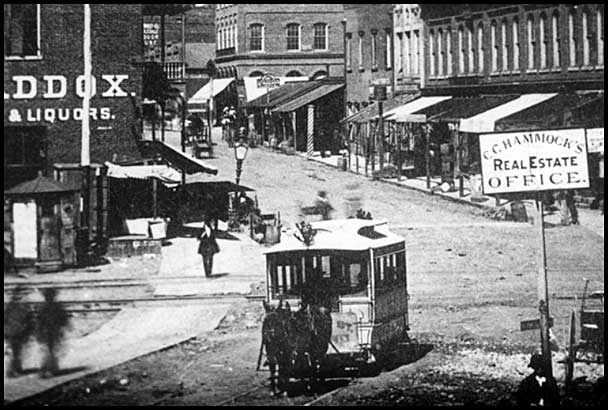
| A mule car on Whitehall (now Peachtree) Street at the railroad tracks in 1872. Curiously, in some published versions of this photograph, the word "liquors" was blotted out. |
| The following year a line from Union Station to points south was constructed. It zigzagged from Alabama Street to the City Hall-Courthouse (now the State Capitol site) and after a couple of more turns ended at the present site of the Olympic Torch Tower.
In early 1874, a line down Whitehall to McDaniel Street opened for business. That year also saw extensions of two older lines as the Peters Street line was extended to West End and the Peachtree Street line was extended to Ponce de Leon Springs. |
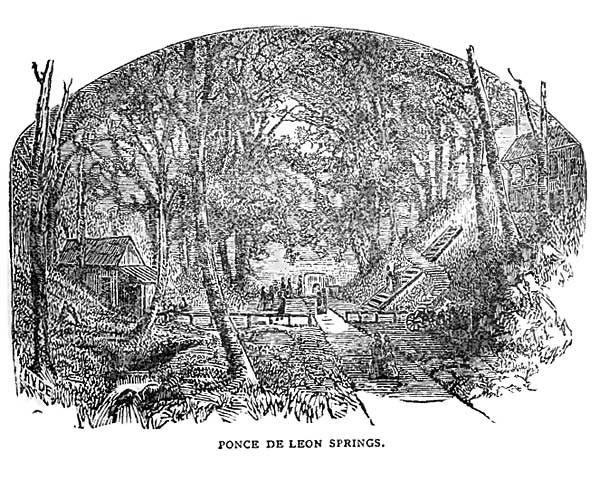
| The latter half of the 1870s saw little street railway construction due to a struggling economy after the Panic of 1873, but in the follwing decade expansion resumed. In 1880, the Marietta Street line was extended to the fair grounds and race track at Oglethorpe Park (which was soon to become the site of the International Cotton Exposition). In 1881, the Peachtree Street line was extended to present-day Fourteenth Street. In 1882, the Whitehall Street line was connected to Peters Street via a new railroad underpass (where Northside Drive now passes under the tracks). This route bypassed the original line to McPherson Barracks, which was taken up. |
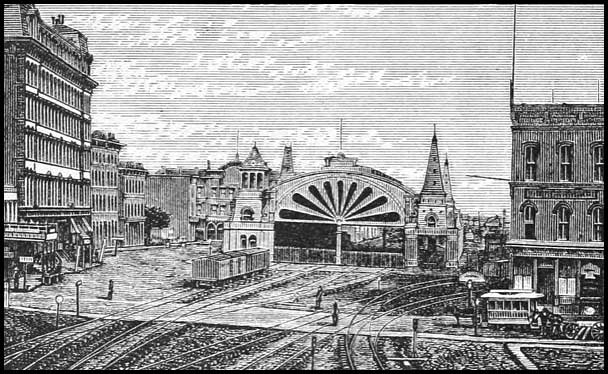
| Mule car on Pryor Street. Union Station of 1871 in center. (From Lawton B. Evans. The Student's History of Georgia. 1884. Online at Internet Archive.) |
|
In 1883, Atlanta's second street railway enterprise, the West End & Atlanta Street Railroad Company, finally started construction after a difficult birth. (It had been chartered in 1872 but may have lost time due to an inventor's "prismoidal one-track railway.") The line began at Marietta and Broad, then ran down Broad to Mitchell to Madison Avenue (now Spring Street) to Nelson to Walker to Peters through present-day Spelman College to West End Avenue to Ashby (Joseph E. Lowery Blvd.) to Porter (Lucile Avenue) to Gordon Street (Ralph David Abernathy Blvd.). The following year it was extended to Westview Cemetery. Also in 1883, the new Metropolitan Street Railway began work on a line from the Union Depot at Pryor Street to the new Grant Park in the southeastern section of the city. 1884 brought yet another company to the scene. The Gate City Street Railroad Company constructed a line from Pryor Street at Decatur Street, up Pryor to Wheat Street (Auburn Avenue today), then Wheat to Jackson to present-day Parkway Drive. Near present-day Angier Avenue the tracks left the streets and took a private right of way to Angier Springs (now the east side of Historic Fourth Ward Park). Meanwhile, also on the north side, the Atlanta Street Railway extended its Peachtree Street line eastward about a quarter-mile down Wilson Avenue (present-day Fourteenth Street). In 1887, the Gate City was sold to a holding company, the Union Street Railroad Company. The new owners abandoned the no-street tracks to Angier Springs and built north up Jackson Street (Parkway Drive) to Ponce de Leon Avenue, then up Boulevard (Monroe Drive) to the Piedmont Exposition site (now Piedmont Park). |
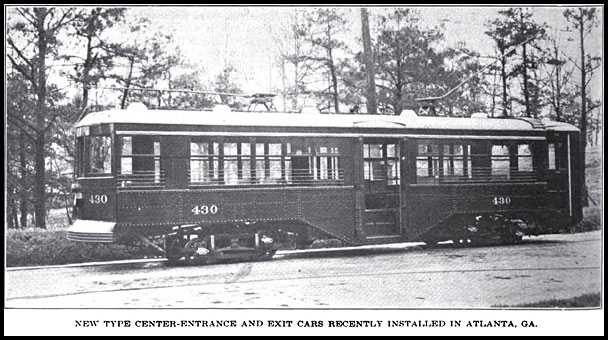
| The mule cars would eventually evolve into cars like this one. |
|
The Metropolitan Street Railway, which had begun construction in 1883, expanded during the 1880s to several areas of southeast Atlanta. Its Pryor Street line was built down that street about two miles to Ridge Avenue, and its Georgia Avenue line branched off Pryor and ran east to Grant Park. Another Metropolitan route branched off Pryor Street at Hunter Street (now Martin Luther King, Jr. Drive), turned south onto Fraser Street, and then ran east on Fair Street (now Memorial Drive) to Oakland Cemetery. It was later extended down a private right of way (now Park Avenue) to the east side of Grant Park as far as Berne Street. Also during the 1880s, the company built its Pulliam Street/Washington Street line. It left Pryor Street at Trinity, ran down Pulliam to Clarke where it turned east for a block and then turned south down Washington Street to end at Ormond Street. (Most of these streets were lost to the interstate highways, stadium, and parking lots built in the 1960s.) During the first decade and a half of Atlanta street railways, horse and mule power was used to move the cars along the rails. As the 1880s moved to a close, this would change. One non-animal power source that was procured was steam, in the form of small locomotives often partially disguised with a streetcar-like enclosure around the engine. Called steam "dummies," these vehicles would pull one or two trailing cars with passengers. Sometimes these were converted horsecars. |

| A steam dummy. |
|
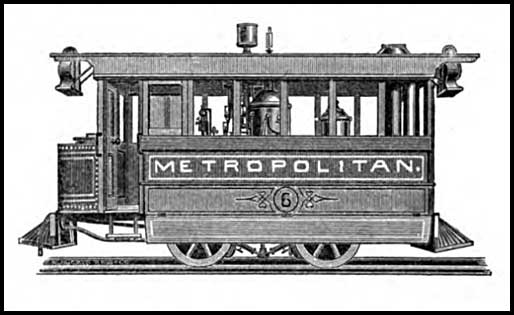
The dummies could travel at several times the speed of horse-drawn cars, which allowed for a faster schedule. Additionally, steam power was a time-tested, reliable technology that had been used on Georgia's rails for a half-century. A downside, however, was smoke from the engine, considered a nuisance on city streets, especially in residential areas. Their faster speeds made dummies appropriate for longer suburban lines, especially those on private rights of way where streets and neighborhoods had not yet been built. Perhaps with such future lines in mind, the Metropolitan Street Railway secured permission in 1887 to operate steam dummies. |
|
H. K. Porter steam dummy used by the Metropolitan. |
|
By 1889, the Metropolitan was operating 7 dummy engines, according to Poors. The company also had 23 horses and 17 cars. This equipment carried 1,106,931 passengers just under a quarter-million miles during the year ending December 31, 1889. An 1888 report on a Porter dummy sold to the Metropolitan provides a bit of information on the steam-powered operation:
The dummies were put to use on the Metropolitan's line to Decatur, which opened in 1891. An extension of the Fair Street (Memorial Drive) line, it ran on mostly private right of way which later became Arkwright Place, Woodbine Avenue, and Oakview Road. Dummies were also used on the company's line to the Confederate Soldiers Home near Grant Park and to Little Switzerland. This line also opened in 1891. Augustus Koch's 1892 birds-eye map of Atlanta (online at Library of Congress website here) shows steam dummies operating on Pryor Street, Park Avenue, Tennelle Street (in Cabbagetown), and on today's Fulton Terrace and Sasseen Street. |
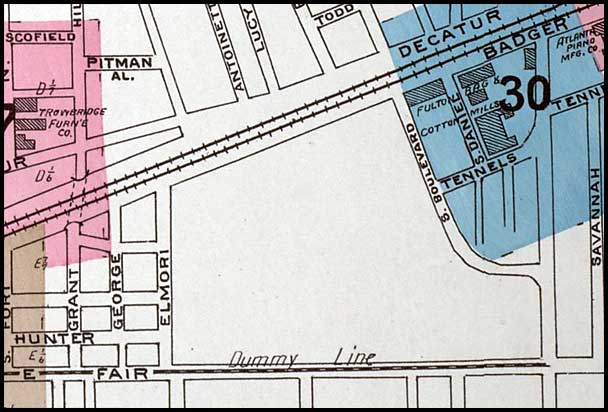
| The Fair Street (now Memorial Drive) line is labeled "Dummy Line" on this 1892 Sanborn map. The empty area in the center is Oakland Cemetery. For a birds-eye view of this area, also from 1892, click here. |
|
In 1887, while the Metropolitan was acquiring steam dummies, a new street railway in Atlanta began construction. It also would choose a non-animal motive power, but instead of tried-and-true steam, it would use the brand-new, and still somewhat tentative, electric traction technology. The Atlanta & Edgewood Street Railroad Company was a venture of Joel Hurt, developer of the city's first planned residential suburb, Inman Park. The street railway was a connection from Inman Park to downtown, traversing the sparsely developed area in between. In fact, it was necessary to construct most of Edgewood Avenue, which at the time only existed for a few downtown blocks under other street names. The railway may have used steam dummies in its earliest months of operation before electric car service began on August 22, 1889. |
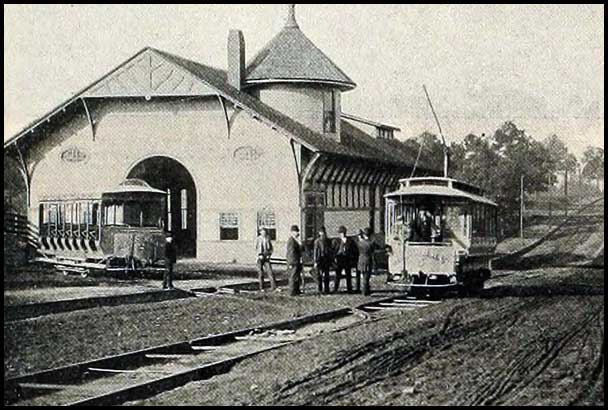
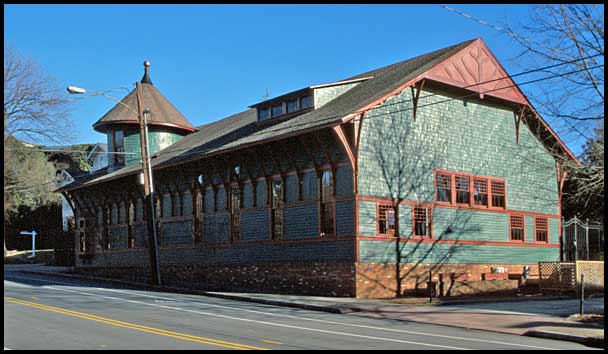
| The Atlanta & Edgewood Street Railroad Company's trolley barn on Edgewood Avenue.(From: Street Railway Review, Vol. 4, 1894, online at Internet Archive here.) |

|
The shingle-style trolley barn is now used as a meeting and events facility. More photos. |
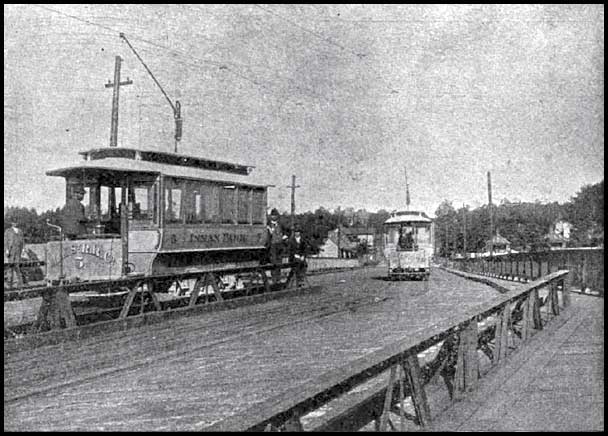
|
Two Inman Park streetcars on the Edgewood Avenue bridge over the Richmond & Danville Railroad. |
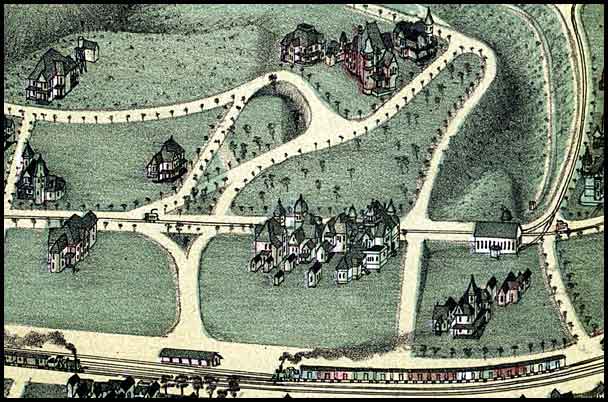
| Part of Inman Park as shown on Koch's 1892 birds-eye map. An electric streetcar is traveling on Edgewood Avenue at Euclid Avenue. The car barn is on the right where tracks diverge. Trains run on the Georgia Railroad at the bottom of the image. The John M. Beath residence, now known as the Beath-Dickey house, is at the top between two other houses. |
|
Shortly before 1889 came to an end, Atlanta's second electric streetcar company, the Fulton County Street Railroad, opened for business. Its line began at Marietta and Broad and then ran up Broad to Peachtree, to Houston Street (now John Wesley Dobbs Avenue), to Hilliard Street, to Highland Avenue, to North Highland Avenue, and to Virginia Avenue. From Virginia it turned south on present-day Monroe Drive and continued down Boulevard back to Highland. The result was a route that looked a bit like a balloon on a string and came to be known as the Nine-Mile Circle. On September 21, 1891, nearly twenty years after Atlanta's first streetcar began service, the two electric railways, along with the Atlanta Street Railway, the West End, and the Gate City were merged into the new Atlanta Consolidated Street Railway Company, led by Joel Hurt. In November of the following year, the Metropolitan was also added to the mix. The resulting system totaled over 50 miles, with some cars powered by electricity, some by steam, and some by horses and mules. Hurt and his associates decided that electrification of the steam and horse lines would take precedence over further expansion. By 1894, some 44 miles had been converted to electric operation. It was during the same year that the last steam dummies ran on the South Decatur and Soldiers Home lines. The establishment of the Atlanta Consolidated in 1891 did not mean the end of competition in the city's streetcar business. The same year, the Atlanta & Chattahoochee River Railway Company was incorporated with the aim of building a line to the new Hollywood Cemetery and to the river. Opening the following year, it ran from Walton and Luckie streets to Jones Avenue to Gray Street to Kennedy Street (now Cameron Madison Alexander Blvd.) to English Avenue to Bellwood Avenue to Mayson-Turner Ferry Road (later Bankhead Highway and now Donald Lee Hollowell Parkway) to Hollywood Road and eventually to the river. In 1892, it was taken over by the Collins Park & Belt Railroad Company, which had been chartered in 1889 but had not constructed any tracks. An 1894 issue of the Street Railway Journal summarized the situation of the CP&B at the time, "The line is suffering considerably from a collapse of the real estate boom, but is still in operation...A portion of the route is through a woody, wild, romantic region, with many curves and grades, but which is rapidly building up with new homes." |
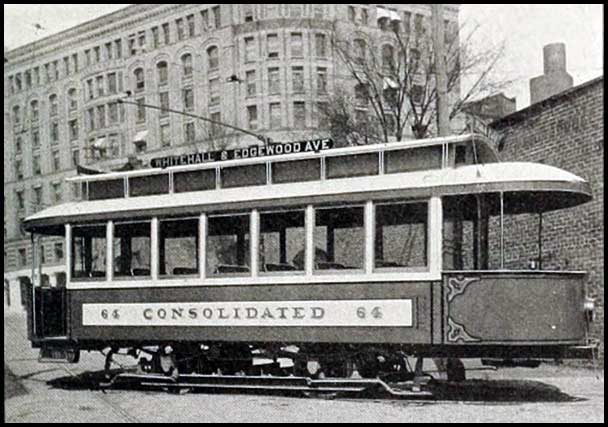
| Atlanta Consolidated Street Railway Company streetcar at Edgewood Avenue. In the background is the Equitable Building of 1892. |
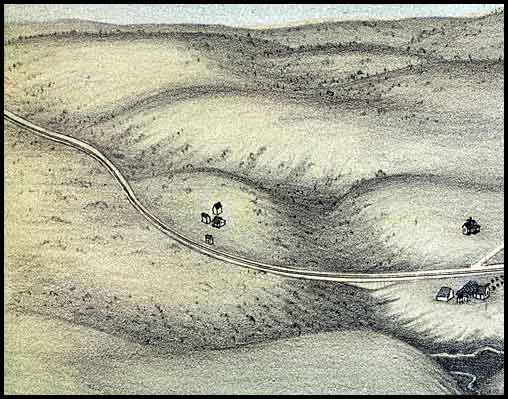
| Koch's 1892 map shows the CP&B's route in today's Maddox Park area. MARTA's Bankhead station is now at this location. |
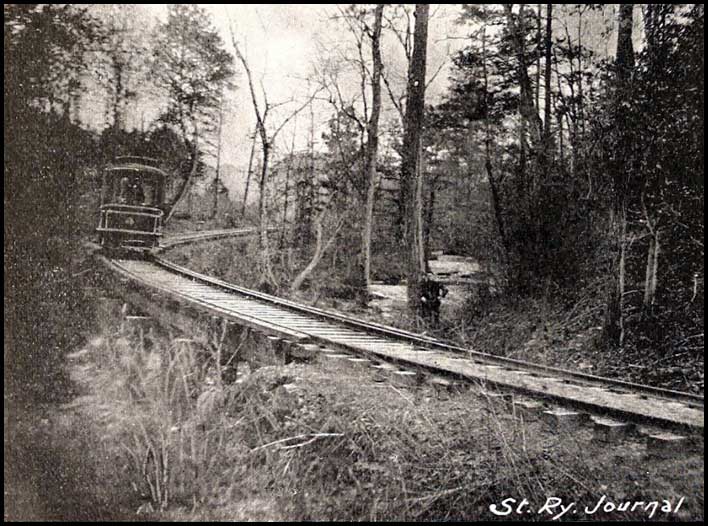
| A CP&B streetcar passes through a wooded stream corridor. (From: Street Railway Journal, March 1894, p. 188.) |
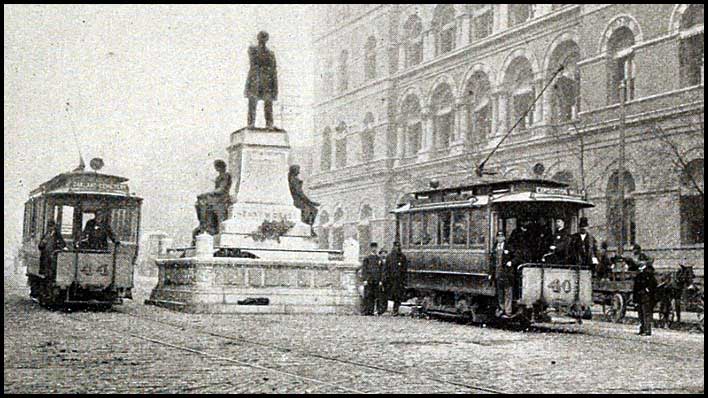
| Southbound car (left) and northbound car (right) on Marietta Street. (From: Street Railway Journal, February 1894, p. 121.) |
|
In 1890-91, another new player, the Atlanta, West End & McPherson Barracks Railway Company, built a line from downtown to Fort McPherson, southwest of the city. (The old McPherson Barracks shut down in the early 1880s; a few years later Spelman College was built on the site. The new fort, built in 1885-88, closed in 2011.) The route began at Broad and Alabama streets, ran along Alabama to Forsyth, then down Forsyth to Fair Street (now Memorial Drive) which it followed a short block before turning south onto Cooper Street. From Cooper it turned west on Richardson then south again onto McDaniel Street. After crossing the ETV&G tracks, it continued down McDaniel through mostly undeveloped properties to the fort. In late 1891, the AWE&MB changed its name to the Atlanta Traction Company. Around this time, a line from Richardson Street to Grant Park was built by the Grant Park Electric Railway Company, which apparently was an arm of the Atlanta Traction Company and not a separate entity. The route was Richardson to Cooper Street to Hendrix Avenue to Pryor Street to Ormond Street to the park. |
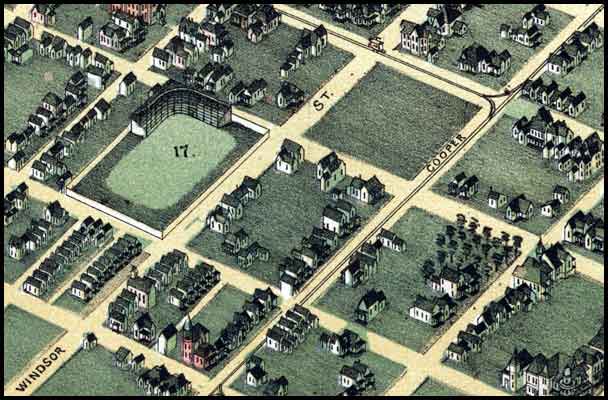
| Here Koch's map shows Brisbane Park, owned by Atlanta Traction Company for "baseball and other amusements," as noted in the map's legend. The Atlanta Crackers of the Southern League played here in 1892 . |
|
In early 1893, construction began on a second line from Atlanta to Decatur. Built by the Atlanta City Street Railway Company, which had been incorporated in November of the previous year, it started at Loyd Street (Central Avenue) on the north side of the Union Depot, then to Decatur Street, to a connection with Ivy Street (Peachtree Center Avenue) to Gilmer Street to Pratt Street to Bell Street to Tanner Street (since obliterated by the Downtown Connector) to Fort Street to Irwin Street to Lake Avenue to Euclid Avenue to McLendon Street, then south at Clifton Road to DeKalb Avenue and on to Decatur. Also, a branch line was built to the old Robert Alston farm which was being developed by the East Lake Land Company for residences and as a resort. Following present-day East Lake Drive, the line intersected the older dummy line at present-day Oakview Road, eventually creating the Oakhurst neighborhood. In 1894-95, the new Atlanta Electric Railway Company built a line to the former city waterworks at Lakewood Park. The route was Loyd Street (Central Avenue), Crew Street, and present-day Lakewood Avenue. The Atlanta City Street Railway and the Atlanta Traction Company did not survive the Panic of 1893. After entering bankruptcy and receivership, the two were closed down and their assets sold in mid-1895 to the new Atlanta Railway Company. This company built a line to the west side of Grant Park, which already had lines via Georgia Avenue and Ormond Street, but which apparently could support a third. The route was Mitchell to Capitol to Woodward to Grant to Augusta to Cherokee to Ormond. |
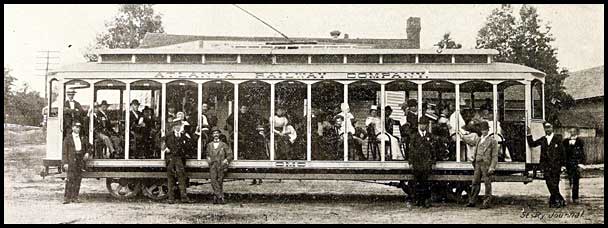
| An open-sided car operated by the Atlanta Railway Company. To enlarge, click here. |
| The Atlanta Railway Company also built lines from Mitchell Street northwest to Magnolia Street and southwest to West Fair Street (now Atlanta Student Movement Blvd). |
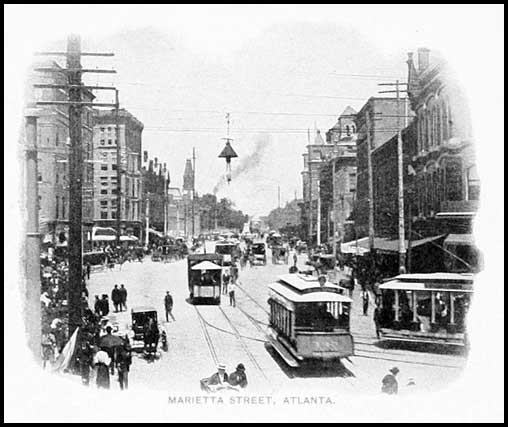
| Marietta Street, viewed from Peachtree Street. (From: The Heart of the South along the line of the Atlanta & West Point RR. Atlanta: Atlanta & West Point RR and Western Railway of Alabama, 1898. Online at Internet Archive.) |
| In 1899, Joel Hurt's Atlanta Consolidated changed its name to the Atlanta Railway & Power Company, indicating an intention to sell electricity for uses other than powering streetcars. The following year it purchased the Atlanta Railway Company. Meanwhile, the Collins Park & Belt Railroad changed its name to Atlanta Rapid Transit Company. This company was associated with Henry M. Atkinson of the Georgia Electric Light Company.
At the time, state law prevented electric light companies from operating street railways, but street railway companies were allowed to own and operate power plants and sell any excess power. Accordingly, it was in Atkinson's interests to associate himself with street railways, without involving his electric light company. By the early years of the twentieth century, horsecars and steam dummies had passed from the scene, and all street railways, in Atlanta at least, would become powered by electricity. Street railways had plenty of room for growth, as did the sale of electricity for general use. It made good business sense to tie the two together. Complicating matters, however, was the existence of two enterprises, Atkinson's Atlanta Rapid Transit Company and Hurt's Atlanta Railway & Power Company, both seeking to dominate the streetcar and electricity businesses in town. |
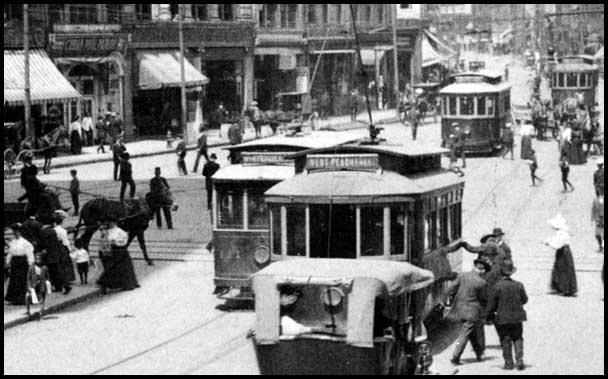
Five Points, early 1900s. (Library of Congress Prints and Photographs Division.)
|
Under Atkinson, the Atlanta Rapid Transit Company expanded its system in 1900-01 to compete directly with many AR&P routes. Among these was a third route to Decatur (via Auburn Avenue, Howell Street, and present-day DeKalb Avenue), another route to Grant Park (via Woodward and Cherokee Avenues), a line to Lakewood via Central Avenue and Crew Street, and lines on Juniper Street, Forrest Avenue (now Ralph McGill Blvd), and Ivy Street (now Peachtree Center Avenue). The Rapid Transit Company provided new cars on several of its routes and reduced fares to attract ridership. The close proximity of the competitive routes meant that many customers came at the expense of the AR&P, which saw a significant decline in profits. |
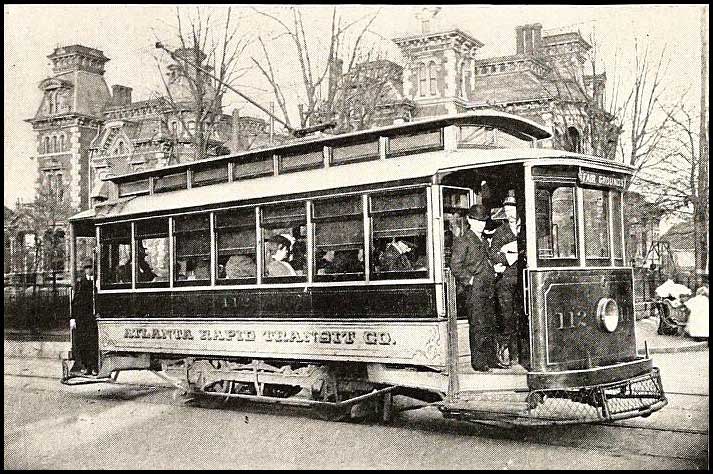
| Atlanta Rapid Transit Co. single-truck car southbound on Peachtree Street at Forrest Avenue (now Ralph McGill Blvd.) |
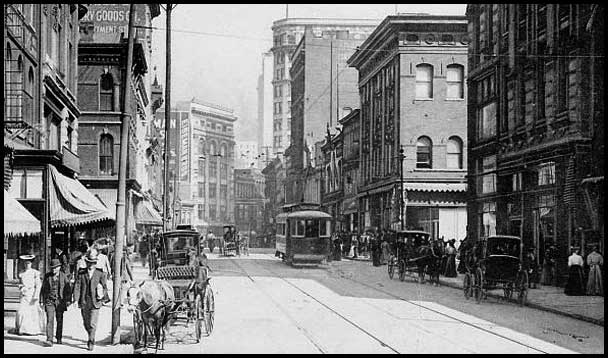
| Whitehall Street, early 1900s. (Library of Congress Prints and Photographs Division.) |
|
In September of 1901, Hurt sold his interests in the AR&P to a Boston investment firm associated with Atkinson. Early in the following year, Atkinson incorporated the Georgia Railway & Electric Company, which soon brought the AR&P, the Atlanta Rapid Transit Company, and the Georgia Electric Light Company into its fold. By paying the city government an annual percentage of gross earnings, the new GR&E and its successors gained a monopoly of the street railways in Atlanta that would last until the 1940s. The GR&E moved quickly to reorganize many routes, building new tracks in some places while abandoning tracks on more than a dozen streets. The northern Decatur line was abandoned east of McLendon at Clifton. This also eliminated the East Lake line (on present-day East Lake Drive), but a route to East Lake via Cottage Grove Avenue remained. The Decatur Street/DeKalb Avenue segment between Howell Street and Hurt Street in Inman Park was also removed. The Fort MacPherson line was shortened; its new terminus was at Dill Avenue at present-day Sylvan Road. Among the new tracks was a 1902 extension from East Point to College Park. Within a decade an interurban connection to Fairburn would follow. |
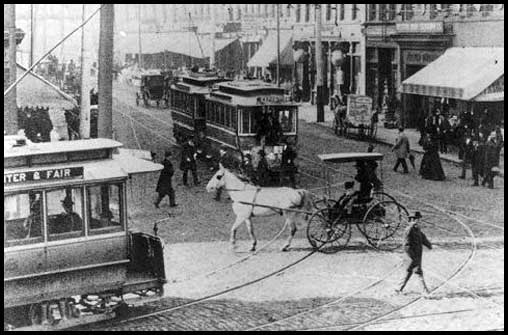
| Downtown Atlanta traffic a century ago included streetcars, buggies, and pedestrians. |
| To increase ridership, the GR&E assisted in the development of the Ponce de Leon amusement park in 1903 and the adjacent Atlanta Crackers baseball park in 1906-07. Both attractions were located at Ponce de Leon Springs on the west side of the Southern Railway. [See also Atlanta BeltLine (and Belt Lines).] |
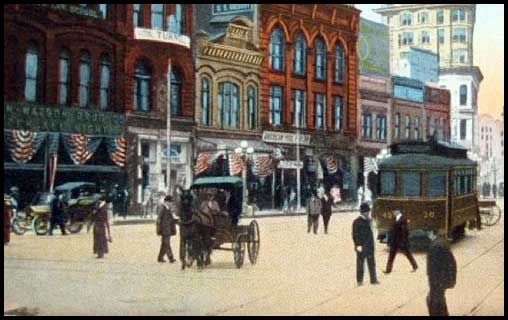
| An automobile, a horse-drawn buggy, and an electric streetcar in early twentieth-century downtown Atlanta. |
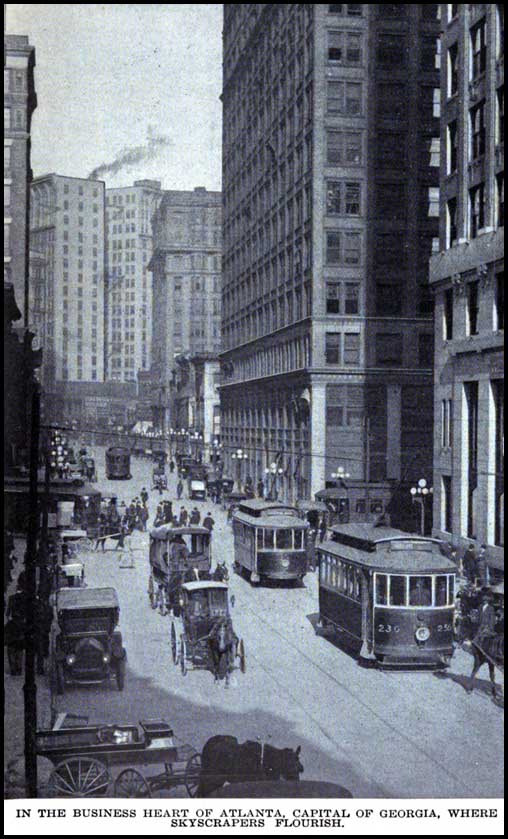
| Streetcars at Broad and Marietta streets. (From: Georgia. Dept. of Agriculture. Georgia: the Empire State of the South: She Is And Will Be ... [Atlanta, Ga.: Byrd printing company], 1915. Online at HathiTrust Digital Library here.) |
|
In 1903, the Atlanta Northern Railway Company was organized by the GR&E to construct an interurban line from Atlanta to Marietta. The first cars ran on the 18-mile route on July 17, 1905. The line began at Walton, Forsyth, and Marietta Streets and ended at the city square in Marietta. Along the way, it passed by Hills Park, Crestlawn Cemetery, Bolton, Gilmore/Oakdale, Campbell's, Smyrna, Fair Oaks, Jonesville, and Glover Machine Works. North of Campbell's the line followed alongside the NC&StL Railroad, first on the west side, then crossing over to the east side on a bridge just north of Fair Oaks (at present-day Atlanta Road bridge over the CSX railroad). The first three miles of the route was on city trackage of the Marietta Street-Inman Yard line, with most of the remaining mileage on private right of way. (See Streetcars in Marietta). |
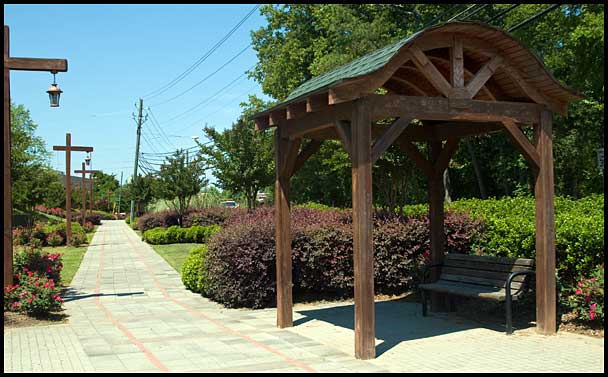
| Cobb County's Trolley Line Park marks the former Atlanta Northern interurban route alongside Log Cabin Drive south of Smyrna. |
By 1907, Atlanta could boast that its trolley network reached every part of the city along with several suburbs:
A line to Hapeville began operations in 1907; it branched off the East Point/College Park line between those two towns. |

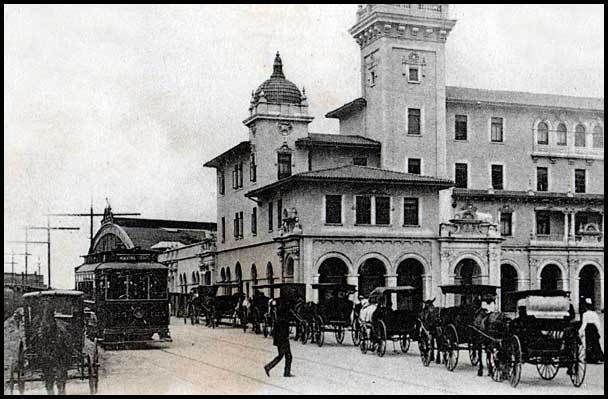
| A streetcar on Mitchell Street passes alongside Atlanta Terminal Station. |
|
While expanding his street railway system, Henry Atkinson also organized other business ventures including a steam railroad, a steamship company, and a mining company. As was the case with his street railway/electric power enterprise, these three investments were intended to be mutually supportive. The railroad would haul his coal and iron, and the steamship line would extend his reach beyond the limits of the rails. Built as the Atlanta, Birmingham & Atlantic, the railroad connected the port city of Brunswick to Manchester, Georgia, where it split into two lines, one to Birmingham and the other to Atlanta. Atkinson's Birmingham Coal & Iron Company and his Brunswick Steamship Company anchored the western and eastern ends, respectively, while his home base of Atlanta anchored the northern end. In early 1909, the AB&A failed, entering bankruptcy and nearly taking the whole of Atkinson's business empire down with it. Despite the financial difficulties of its early years, however, most of the railroad survived and today it forms a major link in the CSX network. |
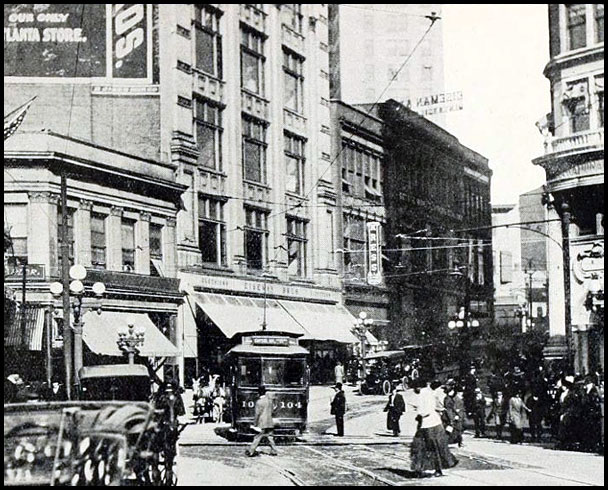
| Streetcar at Whitehall (now Peachtree) and Alabama streets around 1914. Directly behind the streetcar was the Eiseman Building, which was torn down for MARTA's Five Points station. The ornamental arched windows at the top of its Whitehall facade (not visible in this photo) are now a decorative feature inside the station. (From: Atlanta Souvenir, Atlanta: Johnson-Dallis Co., 1914. Online at Internet Archive here.) |
| In 1912, the properties of the Georgia Railway & Electric Company were leased to the Georgia Railway & Power Company, formed the same year to purchase several existing power companies. As part of the arrangement, the GR&P acquired the Morgan Falls hydroelectric plant on the Chattahoochee River and the Tallulah Falls hydroelectric development in Rabun and Habersham counties, then under construction. |
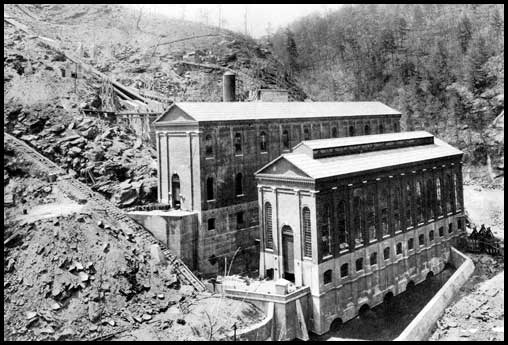
| The power house at Tallulah Falls. The hydroelectric facility helped propel Atlanta's streetcars. |
| An interurban line from Decatur to Stone Mountain opened on November 29, 1913. GR&P built the 9.15-mile line at a cost of just under $400,000.
It began at Sam's Crossing in Decatur, where it connected with the streetcar system. Eastbound, it generally followed present-day East College Avenue, Avondale Road, North Clarendon Avenue, Church Street, and East Ponce de Leon Avenue. Most of the route north of Scottdale was beside the Georgia Railroad (now CSX), beginning on the south side and then passing under the railroad north of Hambrick Road. From there it remained on the railroad's north side into Stone Mountain. (See Streetcars in Stone Mountain). Between Avondale Estates and Stone Mountain, the PATH Foundation's Stone Mountain Trail for pedestrians and bikes now retraces the route. |
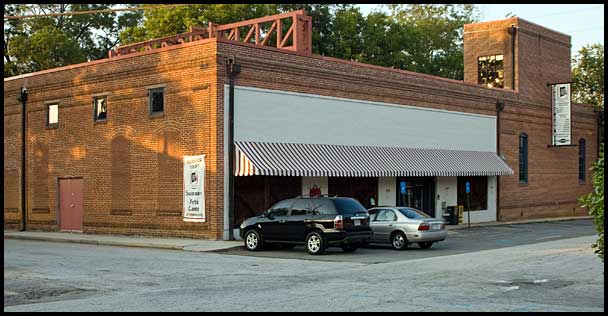
| The interurban car barn and substation in Stone Mountain has survived and is now a local arts center known as ART Station. |
| World War I brought a huge new military facility to the area, Camp Gordon. Located on 2,400 acres near Chamblee, it comprised over 1,600 buildings with barracks for 46,612 men and corral space for 7,688 horses and mules. Although located on the Southern Railway, 14 miles from Five Points, the camp needed a streetcar connection as well. The closest was on Peachtree Road at the county line, three miles to the southwest.
Recognizing that the camp was not likely to be a long-term establishment, the GR&P agreed to a permanent 1.6-mile extension of its line to Oglethorpe University, along with a temporary extension to the camp. The single track line was completed around December of 1917. After the war ended, the camp property was sold and the streetcar line north of the university was removed. |
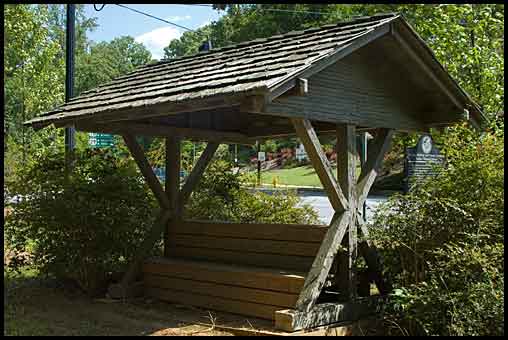
| Old trolley waiting station on Ponce de Leon Avenue, built in 1923. (Photo of historical marker at the site.) |
During the 1920s, several of Georgia's streetcar operations saw major changes in corporate structure. In the spring of 1926, the Georgia Railway & Power Company entered into an alliance with the Southeastern Power & Light Company, and a few months later the Georgia Power Company was formed. This new company consolidated the GR&P, the Athens Railway & Electric Company, and the Rome Railway & Light Company, along with various other properties, into a single system. In 1928, Georgia Power also brought the Macon Railway & Light Company and the properties of the Augusta-Aiken Railway & Electric into its fold. The Columbus Electric & Power Company, which owned the street railway system in that city, was added in 1929-30. Georgia Power Company also began a major upgrade of equipment during the Twenties. A 1927 article (condensed here) described the company's efforts:
|


As indicated in the article, streetcars in Atlanta (and in the southern states generally) were racially segregated at the time. In Georgia, segregation began with the passage in the 1890s of "Jim Crow" laws that required separate accommodations in public facilities and public transit such as streetcars and passenger trains. The shameful practice did not beian to erode until the 1950s and 1960s with the Civil Rights movement. (For a good overview, see the article Segregation at the New Georgia Encyclopedia.) It was during the 1920s and 1930s that rubber-tired vehicles were introduced as supplements to the streetcar system. First, in 1925, Georgia Railway & Power Company established the Atlanta Coach Company, a wholly owned subsidiary that used buses to feed traffic to streetcar lines. In 1937, trackless trolleys, a type of bus powered by overhead electric lines, went into service, first on the East Point-College Park line and in 1940 on the Oglethorpe line. World War II delayed further conversion of streetcar lines to trackless trolley operation, but in 1946 the process resumed, soon making Atlanta a leader in trackless trolley mileage. In 1949, on the River Line in northwest Atlanta, streetcar service in the city began a hiatus that would last more than six decades. |
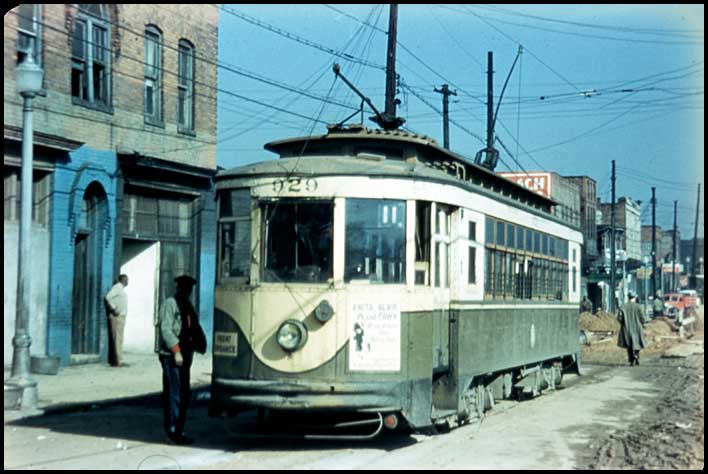
| An Atlanta streetcar in the 1940s. |
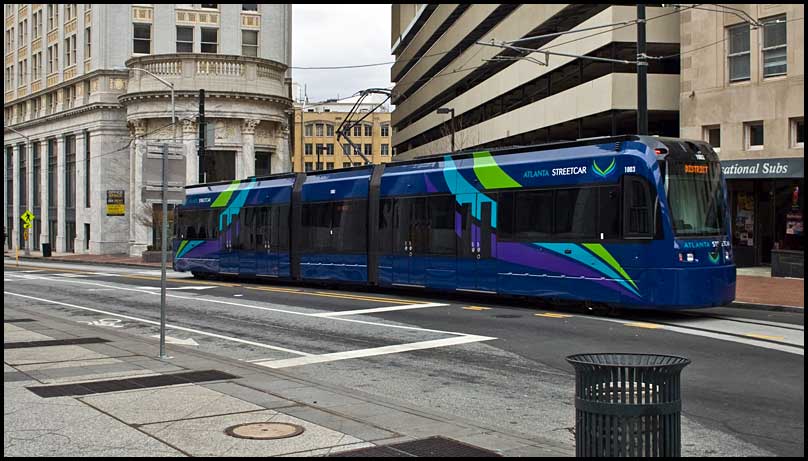
| An Atlanta streetcar in early 2015. |
More Information:
| Historic Streetcar Systems in Georgia by New South Associates. A map of the Georgia Railway and Electric streetcar system in 1902 is online here at Wikimedia Commons. A 1907 map of downtown streetcar lines is here at railga.com. A 1911 map is here at Wikimedia Commons. See newdavesrailpix.com for numerous Georgia Railway & Power Company streetcar photos. |
Suggested Reading:
|
O.E. Carson. The Trolley Titans; A Mobile History of Atlanta. Robert G. Cullen. Baseball and America's Streetcars in the 19th Century. Online at Transportation Research Board here. Jean Martin. Mule to MARTA, two volumes, Atlanta Historical Society, Wade H. Wright. History of the Georgia Power Company; 1855-1956. Atlanta: Georgia Power Company, 1957. |

RailGa.com. Georgia's Railroad History & Heritage. © Steve Storey
Railroad History | The Depot List | Locomotives On Display | Odds & Ends | Sources & References | Home